translation
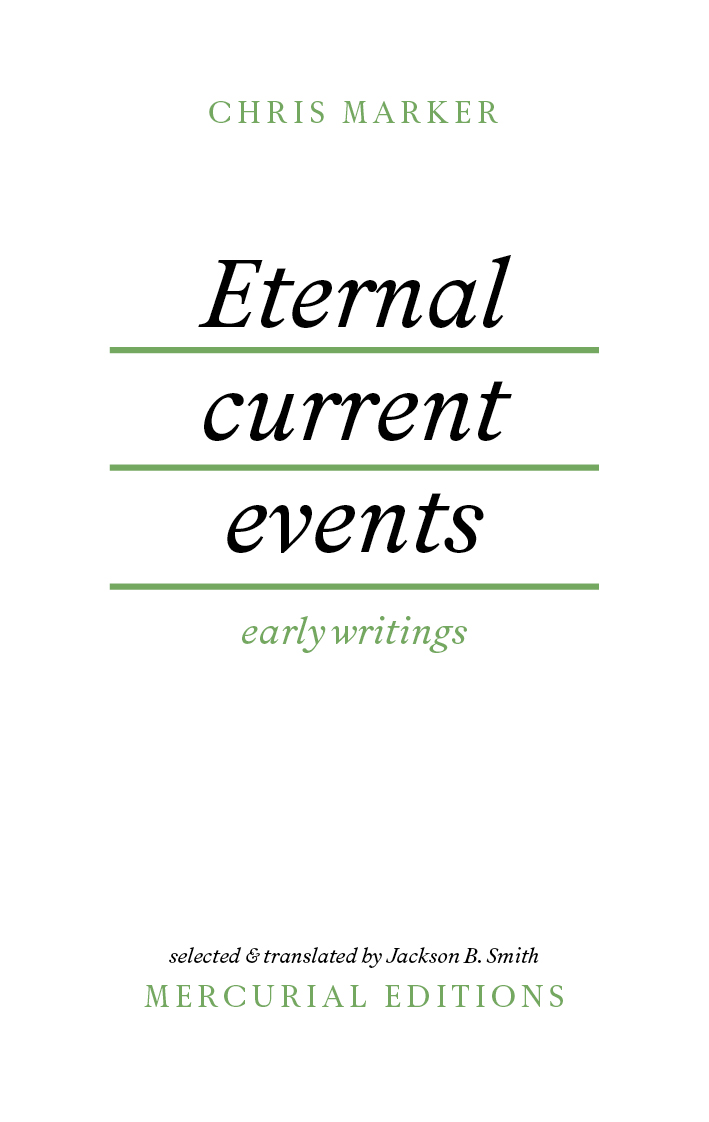
Chris Marker, Eternal Current Events: Early Writings (Mercurial Editions/Inpatient Press) 2024.
Available Here.
“We sometimes have the calming feeling that the real prevails over the imagination and uses its weapons to do so. Some sentences that we discover by chance while reading sound as if they were knowingly fabricated confessions.”
Lionel Ruffel, Our Heroine (2022)
“Thus, a theory of fiction presents itself to us, a coherent one. There’s the real, which is too brutal—it hurts us, we don’t understand a thing. And when we understand, we don’t know what to do, we murder everyone. Fiction filters it and, all of a sudden, we understand better, we stop making a mess of things. We’re purged of our bad passions. Fiction cheats death: that is the theory of the frame-narrative, one that still enlivens us today.”
Lionel Ruffel, Forever Decameron (2020)
“It is needless to say that death awaits. Still, there is something else that is even more frightening: uncontrollable flows of information. A virus like the plague—at the risk of an obvious anachronism—appears to be nothing more than a spreading flow of information. It causes mutations and transforms human bodies by enlarging them with boils, blotches, and animal or vegetal characteristics. The plague destroys each individual’s humanity, just as it destroys each social group’s ties and attachments. Everything becomes contaminated upon contact with the sick. The disease not only attacks bodies in good health—which, of course, is classic—but it also has an effect on clothes, which it transforms into nodes of connection.”
Lionel Ruffel, A Dangerous Book (2018)
“The book is simultaneously material and immaterial; its two-sided nature is the same as that of capitalism, which invests objects with magical qualities by fetishizing them. But thanks to the idea of authority, the book occupies a position at the very top of the hierarchy of merchandise. The book constitutes a separate universe, one that is entirely distinct from action, one without an exterior, its own island of intensity.”
Other translations (selected):
- Ruffel, Lionel. “For an Institutional Literary Critique.” Literary Judgment and the Fora of Criticism,Nobel Symposium, Wallstein Verlag, 2024.
- Marker, Chris. “The Three Cows.” MUBI Notebook, 9 April 2024.
- Fortuné, Maïder. “Interview with Vincent Broqua.” The Beyond Within, The Robert McLaughlin Gallery, 2024.
- Marker, Chris. “Imaginary Current Events.” The Baffler, 5 Jul. 2023.
- Taïa, Abdellah. “Mekka-La-Chapelle.” PALAIS: The Magazine of the Palais de Tokyo, No. 34, “Shéhérazade, la nuit,” October 2022, pp. 110-113.
- Gourmel, Yoann. “Scheherazade, at Night.” PALAIS: The Magazine of the Palais de Tokyo, No. 34, “Shéhérazade, la nuit,” October 2022, pp. 16-17.
- Puff, Jean-François. “Constraint and Rule: Oulipo and the Neos.” Neo-Avant-Gardes: Post-War Literary Experiments Across Borders, ed. Bart Vervaeck. Edinburgh: Edinburgh UP, 2021, pp. 281-293.
- Théval, Gaëlle. “Sound Poetry in France: A Neo-Avant-Garde?” Neo-Avant-Gardes: Post-War Literary Experiments Across Borders, ed. Bart Vervaeck. Edinburgh: Edinburgh UP, 2021, pp. 143-163.
- Ruffel, Lionel. “Literary Curiosities.” Electra, No. 12, Spring 2021.
- Gallo Lassere, Davide and Fréderic Monferrand. “The Adventures of Activist Inquiry.” Rue Descartes, No. 96, 2019, pp. 93-107.
- Pagès, Claire. “Some Remarks on a Comparison between the Frankfurt School and ‘Socialism or Barbarism’.” Rue Descartes, No. 96, 2019, pp. 127-150.
- Message, Vincent. “The Articulation of Violence in Fiction on Contemporary Capitalism.” Contemporary French and Francophone Studies, vol. 23, no. 3, 2019, pp. 369-376.
- Berger, Anne-Emanuelle. “Interview with Anne-Emmanuelle Berger, Conducted by Isabelle Alfandary.” Rue Descartes, No. 95, 2019, pp. 58-78.
- Calle-Gruber, Mireille. “Stages that Make the Night More Livable than the Days: (Performing Sexual Differences).” Rue Descartes, No. 95, 2019, pp. 4-21.
 JACKSON B SMITH